The soft landing scenario for the U.S. economy became even more likely with today's economic data that shows the economy is still chugging along on almost all cylinders.
Growth was revised for the 3rd quarter to be quite a bit stronger. From the front page of the WSJ -
GDP Growth Revised Up to 2.2% For 3rd Period on Less Trade Drag
WASHINGTON -- The U.S. economy was stronger last summer than first thought because businesses accumulated more inventory and trade was less of a drag. Gauges measuring third-quarter inflation were lowered slightly, according to Wednesday's data revisions.
Gross domestic product increased at a 2.2% annual rate July through September, the Commerce Department said Wednesday in its first revision to third-quarter 2006 GDP. The government initially estimated growth at 1.6%......
Also, the Fed's favorite inflation indicator continued to move downward. This gives the Fed more room to maneuver funds rates down as the bond market has priced in by about 52%
...The government's price index for personal consumption increased 2.4%, lower than the previously estimated 2.5% climb but below the second quarter's 4.0% rise. The PCE price gauge excluding food and energy increased 2.2%, lower than the previously estimated 2.3% climb and below the second quarter's 2.7% rise.
What about American companies how are they doing? Well just fine thank you!
...Corporate profits after taxes climbed 4.6% to $1.167 trillion in July through September from the second quarter, the report showed. In the second quarter, profits increased 0.3%. Year-to-year, profits surged 31.5% since the third quarter of 2005.
And what are these profitable companies doing with their cash you ask?
...Businesses increased third-quarter spending more than previously thought. Outlays rose 10.0% July through September, higher than the originally estimated 8.6% advance. Business spending rose 4.4% in the second quarter. Third-quarter investment in structures surged 16.7%. Equipment and software increased 7.2%.
And lastly, don't forget about the American consumer......urh.................the energizer bunny..
Third-quarter spending by consumers increased 2.9%, down from a previously reported 3.1% but above the second quarter's 2.6% advance.
By JEFF BATER - WSJ
Wednesday, November 29, 2006


Monday, November 27, 2006
Strong outlook for holiday retail
Another article regarding the strong holiday shopping season
Most forecasts run 5 to 6 percent above 2005, promising a lift for the US economy.
NEW YORK – The US economy is about to get its largest jolt of the year: the annual holiday buying blitz that ends 31 days from Friday.
By the time all the wrapping paper is discarded, Americans will spend $676 per household, for an estimated total of $251 billion, according to one survey - an amount more than the annual gross domestic product of Chile and Israel combined.
The nation's holiday spending, even adjusted for inflation, sets a record every year, and this year will be no exception. Surveys and analysts predict holiday spending will rise about 5 to 6 percent over last year, which was 6.1 percent higher than 2004. If this level of spending prevails, it will give merchants - and the economy as a whole - a solid foundation going into 2007....
...Americans will be entering the holiday period with enough cash in their pockets, or room on their credit cards, to happily hit the malls, some economists and retail experts say. "Every month this year, all the way back to last October, there has been an increase in real disposable income," says Richard Feinberg, a researcher at the Purdue Retail Institute in West Lafayette, Ind....
By Ron Scherer Staff writer of The Christian Science Monitor
Most forecasts run 5 to 6 percent above 2005, promising a lift for the US economy.
NEW YORK – The US economy is about to get its largest jolt of the year: the annual holiday buying blitz that ends 31 days from Friday.
By the time all the wrapping paper is discarded, Americans will spend $676 per household, for an estimated total of $251 billion, according to one survey - an amount more than the annual gross domestic product of Chile and Israel combined.
The nation's holiday spending, even adjusted for inflation, sets a record every year, and this year will be no exception. Surveys and analysts predict holiday spending will rise about 5 to 6 percent over last year, which was 6.1 percent higher than 2004. If this level of spending prevails, it will give merchants - and the economy as a whole - a solid foundation going into 2007....
...Americans will be entering the holiday period with enough cash in their pockets, or room on their credit cards, to happily hit the malls, some economists and retail experts say. "Every month this year, all the way back to last October, there has been an increase in real disposable income," says Richard Feinberg, a researcher at the Purdue Retail Institute in West Lafayette, Ind....
By Ron Scherer Staff writer of The Christian Science Monitor
Predictions of a Happy Holiday Season
According to a recent article in Businessweek there are some good reasons to be merry. With low unemployment, rising wages, low inflation, lower gas prices, and a possible bottoming out in housing, expectations are for a solid holiday shopping season.
U.S.: The Housing Grinch Won't Steal Christmas
Wallets are open, and even the outlook for home sales is improving
"....Retailers can put their fears behind them--and that's good news for the overall economy this quarter and next. Consumers are heading into the holidays buoyed by the sturdiest set of spending fundamentals in years. The labor markets are strong, with the unemployment rate at a 5 1/2--year low of 4.4%. Gasoline prices are down 26% since early August, resulting in a windfall of purchasing power for household incomes...
There is still almost no evidence of spillover effects from the housing downturn on consumer buying. That means the slump remains confined to the housing sector....
...based on the latest readings on retail sales and consumer prices through October, consumer spending in the fourth quarter is speeding up...."
The real story is despite the headline numbers retail sales have improved lately as described below.
"...RECENT GOVERNMENT REPORTS on retail sales require a careful reading. October sales dropped 0.8% from September, when they fell 0.2% from August. Those declines mainly reflected back-to-back decreases in gas station receipts of 11.1% and 6%, indicating lower pump prices, not less gasoline buying. In addition, retail sales of building materials and supplies fell for the third consecutive month. For purposes of measuring GDP growth, though, the government counts that activity as part of residential construction, not consumer spending. Overall retail sales from July to October fell at a 4% annual rate, but sales excluding gas and building materials grew at a healthy 5.1% rate. The bottom line is that consumer spending on most items began the final quarter with a head of steam, fueled largely by the additional buying power fueled by falling energy prices."
And Headline inflation is decelerating quickly
"...THAT BOOST WAS EVIDENT from the overall consumer price index in September and October. It posted monthly declines of 0.5% in each month, the largest two-month drop since 1948. The fourth-quarter CPI will actually be below the level for the previous quarter, a rare event in the past half century.
That means the same paycheck this quarter will buy more goods and services than it did last quarter. For example, the Labor Dept. reported that real weekly earnings of production workers in October increased 1.3% from September, when they rose 1% from August. Those were the biggest back-to-back gains in 24 years..."
And what about housing, is it bottoming?........
"...Consumer momentum is the chief reason retailers shouldn't fret about the housing slump spoiling their holiday party. Clearly, some of the housing-related data of late have looked alarming, especially the surprisingly large drop in October housing starts. But that decline might have been an exaggeration. The huge 26.4% plunge in new home starts in the South was one of the largest on record for that region. Several analysts say the swoon might have been due to exceptionally wet weather in that region. If so, the weakness may well reverse in November....
Several sales indicators appear to be stabilizing even as builders work through their stocks of unsold homes.......Strengthening demand is particularly noticeable in the new-home market, where sales increased in both August and September, the first two-month rise in a year and a half....
...THE MOST FAVORABLE SIGN that demand for homes will continue to firm comes from weekly mortgage applications to buy a house. Not only have applications stopped falling, their three-month average is now rising after declining steeply for more than a year. The applications statistics foreshadow data on housing sales, and sales are what drive new building....
By James C. Cooper - Businessweek
U.S.: The Housing Grinch Won't Steal Christmas
Wallets are open, and even the outlook for home sales is improving
"....Retailers can put their fears behind them--and that's good news for the overall economy this quarter and next. Consumers are heading into the holidays buoyed by the sturdiest set of spending fundamentals in years. The labor markets are strong, with the unemployment rate at a 5 1/2--year low of 4.4%. Gasoline prices are down 26% since early August, resulting in a windfall of purchasing power for household incomes...
There is still almost no evidence of spillover effects from the housing downturn on consumer buying. That means the slump remains confined to the housing sector....
...based on the latest readings on retail sales and consumer prices through October, consumer spending in the fourth quarter is speeding up...."
The real story is despite the headline numbers retail sales have improved lately as described below.
"...RECENT GOVERNMENT REPORTS on retail sales require a careful reading. October sales dropped 0.8% from September, when they fell 0.2% from August. Those declines mainly reflected back-to-back decreases in gas station receipts of 11.1% and 6%, indicating lower pump prices, not less gasoline buying. In addition, retail sales of building materials and supplies fell for the third consecutive month. For purposes of measuring GDP growth, though, the government counts that activity as part of residential construction, not consumer spending. Overall retail sales from July to October fell at a 4% annual rate, but sales excluding gas and building materials grew at a healthy 5.1% rate. The bottom line is that consumer spending on most items began the final quarter with a head of steam, fueled largely by the additional buying power fueled by falling energy prices."
And Headline inflation is decelerating quickly
"...THAT BOOST WAS EVIDENT from the overall consumer price index in September and October. It posted monthly declines of 0.5% in each month, the largest two-month drop since 1948. The fourth-quarter CPI will actually be below the level for the previous quarter, a rare event in the past half century.
That means the same paycheck this quarter will buy more goods and services than it did last quarter. For example, the Labor Dept. reported that real weekly earnings of production workers in October increased 1.3% from September, when they rose 1% from August. Those were the biggest back-to-back gains in 24 years..."
And what about housing, is it bottoming?........
"...Consumer momentum is the chief reason retailers shouldn't fret about the housing slump spoiling their holiday party. Clearly, some of the housing-related data of late have looked alarming, especially the surprisingly large drop in October housing starts. But that decline might have been an exaggeration. The huge 26.4% plunge in new home starts in the South was one of the largest on record for that region. Several analysts say the swoon might have been due to exceptionally wet weather in that region. If so, the weakness may well reverse in November....
Several sales indicators appear to be stabilizing even as builders work through their stocks of unsold homes.......Strengthening demand is particularly noticeable in the new-home market, where sales increased in both August and September, the first two-month rise in a year and a half....
...THE MOST FAVORABLE SIGN that demand for homes will continue to firm comes from weekly mortgage applications to buy a house. Not only have applications stopped falling, their three-month average is now rising after declining steeply for more than a year. The applications statistics foreshadow data on housing sales, and sales are what drive new building....
By James C. Cooper - Businessweek
Sunday, November 19, 2006
Bay Area "Percolating" With High Paying Jobs
The bay area is a good prognosticator for the future health of the northern California economy including Sacramento and the Central Valley. As an anchor of innovation, this area has rapidly been growing high paying jobs (just think Google, Youtube, Facebook, etc). Make no mistake, this is not the high flying dot com era that seems like a distant memory today, rather these are solid companies with real profits and promise.
Peninsula job growth is brewing
"Job growth in the San Francisco metro area appears to be percolating, buoyed by a trend toward adding high-paying positions, according to report released Friday....
...For the 19th consecutive month, the metro area that includes San Mateo, San Francisco and Marin counties added jobs on a year-over-year basis. The area tacked on 17,400 jobs over the past year, up 1.8 percent, outpacing both the state (up 1.1 percent) and rival East Bay (up 1.6 percent), according to the state Employment Development Department....
...San Mateo County's unemployment rate slipped to 3.3 percent in October, the lowest rate since May 2001 and the lowest October rate since 2000, when it was 2.7 percent....
...Meanwhile, California's unemployment rate fell to a record low of 4.5 percent in October, down from 4.8 percent in September. It was the state's lowest rate since the current employment data series was established in 1976....
....The San Francisco metro area gained 4,800 jobs between September and October. That's several times greater than the average September-to-October increase of 1,100 over the past 15 years, said Ruth Kavanagh, West Bay labor market specialist with the Employment Development Department.... "
By Tim Simmers, BUSINESS WRITER - Insidebayarea.com (Link)
Peninsula job growth is brewing
"Job growth in the San Francisco metro area appears to be percolating, buoyed by a trend toward adding high-paying positions, according to report released Friday....
...For the 19th consecutive month, the metro area that includes San Mateo, San Francisco and Marin counties added jobs on a year-over-year basis. The area tacked on 17,400 jobs over the past year, up 1.8 percent, outpacing both the state (up 1.1 percent) and rival East Bay (up 1.6 percent), according to the state Employment Development Department....
...San Mateo County's unemployment rate slipped to 3.3 percent in October, the lowest rate since May 2001 and the lowest October rate since 2000, when it was 2.7 percent....
...Meanwhile, California's unemployment rate fell to a record low of 4.5 percent in October, down from 4.8 percent in September. It was the state's lowest rate since the current employment data series was established in 1976....
....The San Francisco metro area gained 4,800 jobs between September and October. That's several times greater than the average September-to-October increase of 1,100 over the past 15 years, said Ruth Kavanagh, West Bay labor market specialist with the Employment Development Department.... "
By Tim Simmers, BUSINESS WRITER - Insidebayarea.com (Link)
Home Prices Could Go Up in 2007
Is it possible that the worst is behind us in many housing markets? With builders starting less homes and clearing out their inventories with incentives, what many would call a "supply correction" due to excess speculation might be passing soon. Just like it was hard to call the top of the market until it passed(August 2005) it will be very hard to call the bottom (now??? or soon) until 3-6 months after it has already happened.
This business week article (Biz Week )discusses the Boston Fed's analysis (Boston Fed Link)that house prices might increase next year.
This Just In From Boston ... Prices "Could Keep Increasing"
".........What makes the Boston Fed at least mildly positive on the market? Looking at housing cycles state by state, senior economist Yolanda K. Kodrzyicki and research associate Nelson Gerew conclude that "house prices have rarely decreased in the absence of a state recession."
Here's the tentative bottom line: "Assuming continued increases in personal incomes, an increase in mortgage rates in 2006, and flat apartment rates, an extrapolation suggests that national house price increases are likely to be in the range of 1 to 3 percent in 2006 and 2 to 5 percent in 2007."
This business week article (Biz Week )discusses the Boston Fed's analysis (Boston Fed Link)that house prices might increase next year.
This Just In From Boston ... Prices "Could Keep Increasing"
".........What makes the Boston Fed at least mildly positive on the market? Looking at housing cycles state by state, senior economist Yolanda K. Kodrzyicki and research associate Nelson Gerew conclude that "house prices have rarely decreased in the absence of a state recession."
Here's the tentative bottom line: "Assuming continued increases in personal incomes, an increase in mortgage rates in 2006, and flat apartment rates, an extrapolation suggests that national house price increases are likely to be in the range of 1 to 3 percent in 2006 and 2 to 5 percent in 2007."
By Peter Coy - Businessweek
Saturday, November 18, 2006
California Unemployment at 30 year Low
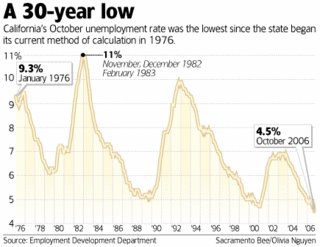
Excerpts from Sac Bee Article
"..........State officials announced Friday that California's unemployment rate fell to 4.5 percent in October, the lowest since the state began modern record-keeping in 1976. The rate dropped three-tenths of a percent since September, prompting Gov. Arnold Schwarzenegger to herald the "fantastic news.".......
........Meanwhile, Sacramento-area unemployment fell three-tenths of a point, to 3.9 percent. That's the first time it's been below 4 percent since the tech boom......
........."The restaurant industry's been hot," Lyons said, noting the wave of new places that have opened in midtown and downtown Sacramento, as well as Roseville, in the past year. The leisure and hospitality sector has added 4,600 jobs in the past year, or more than a quarter of all the new jobs in the region.
The region's manufacturing industry has stabilized. Affymetrix Inc., the West Sacramento biotech manufacturer, is expanding, while NEC Electronics' Roseville chip plant has been gradually rebounding from a severe slump, Lyons said. Siemens Transportation Systems Inc.'s light-rail plant in Sacramento is doing well, he said.......
The region's manufacturing industry has stabilized. Affymetrix Inc., the West Sacramento biotech manufacturer, is expanding, while NEC Electronics' Roseville chip plant has been gradually rebounding from a severe slump, Lyons said. Siemens Transportation Systems Inc.'s light-rail plant in Sacramento is doing well, he said.......
Overall, payroll jobs have increased by 1.1 percent since last October. Roth said the job market remains healthy despite the construction slowdown.
"If you're looking for a job, I think your chances are pretty good," he said. "Labor markets are tight and employers are looking for people."
By Dale Kasler Sac Bee
Tuesday, November 14, 2006
A Little Perspective on Housing?
High Profits Even in Slumping Markets
In October, the average San Diego home sold for $485,000, a 5.5% decline from October of 2005. The actual number of homes sold was down 21% year-over-year. But that doesn't mean all those sellers were losers. Hardly. According to research from First American Real Estate Solutions, a real estate data unit of title insurer First American, the average home seller in San Diego made a profit of $243,000 that month. That's the different between the price they bought it at, five years ago on average, and what they sold it for today. First American calcuates that only 6% of San Diego sellers lost money on their homes, most likely because they bought it in just the past year. The story looks even better in other parts of Southern California where home prices have held up better than San Diego. In San Bernadino County, east of Los Angeles, the average home seller made a $203,000 profit on the typical $360,000 home. That's an average annual return of 25% over the four-year average holding period. The First American data is a reminder that many people still have a tremendous amount of equity in their homes, even if some their neighbors have had to lower their asking prices.
Nov 15, 2006 - Chris Palmeri - Businessweek
25% - That's a pretty good return on investment, not to mention the leveraged return is much higher.
Businessweek Article
In October, the average San Diego home sold for $485,000, a 5.5% decline from October of 2005. The actual number of homes sold was down 21% year-over-year. But that doesn't mean all those sellers were losers. Hardly. According to research from First American Real Estate Solutions, a real estate data unit of title insurer First American, the average home seller in San Diego made a profit of $243,000 that month. That's the different between the price they bought it at, five years ago on average, and what they sold it for today. First American calcuates that only 6% of San Diego sellers lost money on their homes, most likely because they bought it in just the past year. The story looks even better in other parts of Southern California where home prices have held up better than San Diego. In San Bernadino County, east of Los Angeles, the average home seller made a $203,000 profit on the typical $360,000 home. That's an average annual return of 25% over the four-year average holding period. The First American data is a reminder that many people still have a tremendous amount of equity in their homes, even if some their neighbors have had to lower their asking prices.
Nov 15, 2006 - Chris Palmeri - Businessweek
25% - That's a pretty good return on investment, not to mention the leveraged return is much higher.
Saturday, November 11, 2006
U.S. Wages grow by most in 4 years
Despite the mainstream media complaints about only the "rich" (do people making $50k count?) real hourly wages are growing at the fastest pace in four years, and the costs of benefits (i.e. healthcare) are on track to grow at the smallest rate since the 1990's. So real disposable income for U.S. workers is on the rise and should underpin consumer spending .
"Employers are getting the upper hand on the surging costs of benefits, particularly those of health insurance. But while companies are making many employees pay a bigger share of health-care premiums, the tighter labor market is also leading Corporate America to give back some of those savings in the form of fatter paychecks.
By James Mehring in New YorkBy James C. Cooper - Businessweek - Nov 13, 2006
"Employers are getting the upper hand on the surging costs of benefits, particularly those of health insurance. But while companies are making many employees pay a bigger share of health-care premiums, the tighter labor market is also leading Corporate America to give back some of those savings in the form of fatter paychecks.
Third-quarter figures from the employment cost index (ECI) showed benefit costs rising at a 3.3% pace from a year ago. That's the slowest gain in at least five years.........Costs in 2006 are on track to grow at the smallest rate since the late 1990s. Looking ahead, human resource companies Hewitt Associates and Towers Perrin are forecasting further deceleration in employer health-care costs for 2007.
The ECI data, which adjusts for changes in the composition of the labor force, showed that wages and salaries grew by 3.2% from a year ago, the biggest rise in more than four years. Those figures validate other pay indicators, such as average hourly earnings, which stood at a multiyear high in September.
Meanwhile, overall inflation is also slowing down as gasoline, oil, and natural gas prices have fallen off summer highs. The combination of improving income gains and slower inflation will translate into higher inflation-adjusted wages for workers and provide plenty of support for consumer spending."By James Mehring in New YorkBy James C. Cooper - Businessweek - Nov 13, 2006
Friday, November 10, 2006
Housing Market Bottomed - Already?
Mortgage rates and new home sales
In a recent post by Dr James Hamilton of the University of San Diego Econobrowser
he suggests that there is a 4-5 month lag between interest rates (both the Fed Funds rate and mortgage rates) and it's affect on a would be new home buyer's decision to purchase. He also notes a direct correlation to anticipated Fed Funds future rates and upcoming new home sales. Most importantly as we move into a period of quite likely, lower rates, housing should improve and he suggests we may have already bottomed out.
"I also noted in my previous post that the fact that the Fed has stopped raising the fed funds rate was a factor in bringing mortgage rates down since this summer. But because mortgage rates had previously been rising up through the beginning of July, the lags in the process mean that one would expect to see home sales falling relative to the usual seasonal pattern in August and September, even though the mortgage rate by then was coming down. Given the rate hikes in the spring and early summer and the long lags in the process, I calculate that recent changes in the mortgage borrowing rate have on balance been a factor causing home sales to be lower than they otherwise would have been up through the middle of October.It is only within the last few weeks that one would expect to see home sales stop falling as a result of the policy change that first began to be recognized this summer.
It was partly because of this calculation that I have been more open than many other analysts to the possibility that the most recent data might be suggesting that the bottom for home sales may indeed have already been reached. However, even if sales now stabilize, the inventory of unsold homes will continue to put downward pressure on house prices and employment, either of which could easily become a new factor in the unfolding story. But what we can say is that one very important fundamental has now turned from negative to positive."
Posted by James Hamilton at November 8, 2006 05:25 AM
In a recent post by Dr James Hamilton of the University of San Diego Econobrowser
he suggests that there is a 4-5 month lag between interest rates (both the Fed Funds rate and mortgage rates) and it's affect on a would be new home buyer's decision to purchase. He also notes a direct correlation to anticipated Fed Funds future rates and upcoming new home sales. Most importantly as we move into a period of quite likely, lower rates, housing should improve and he suggests we may have already bottomed out.
"I also noted in my previous post that the fact that the Fed has stopped raising the fed funds rate was a factor in bringing mortgage rates down since this summer. But because mortgage rates had previously been rising up through the beginning of July, the lags in the process mean that one would expect to see home sales falling relative to the usual seasonal pattern in August and September, even though the mortgage rate by then was coming down. Given the rate hikes in the spring and early summer and the long lags in the process, I calculate that recent changes in the mortgage borrowing rate have on balance been a factor causing home sales to be lower than they otherwise would have been up through the middle of October.It is only within the last few weeks that one would expect to see home sales stop falling as a result of the policy change that first began to be recognized this summer.
It was partly because of this calculation that I have been more open than many other analysts to the possibility that the most recent data might be suggesting that the bottom for home sales may indeed have already been reached. However, even if sales now stabilize, the inventory of unsold homes will continue to put downward pressure on house prices and employment, either of which could easily become a new factor in the unfolding story. But what we can say is that one very important fundamental has now turned from negative to positive."
Posted by James Hamilton at November 8, 2006 05:25 AM
Monday, November 06, 2006
Good Riddance


If this doesn't qualify as good news, then nothing will. Though you'd have to have been sleeping under a rock to be unaware of this colossal decision, it's worth taking a moment to thank our troops for bringing this monster to justice.
BAGHDAD, Nov. 5 — Three and a half years after American troops captured Baghdad and ended the dictatorship of Saddam Hussein, the Iraqi court set up to judge the brutalities of his 24 years in power found him guilty on Sunday of crimes against humanity and sentenced him to death by hanging.
By JOHN F. BURNS and KIRK SEMPLE
Published: November 6, 2006
New York Times
Record Low Unemployment
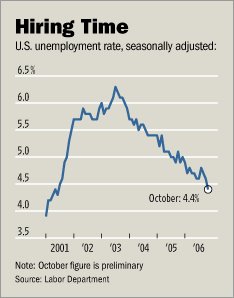
Strong Growth In New Jobs Eases Economy Worries
Wall Street Journal
So first the BLS revised it's job figures a few months ago and found another 800,000 jobs for the past year, then they revised both August and Septembers figures yet higher again. Unemployment in the U.S. is now at a record low and the economy is generating on average 160k jobs per month.
The Labor Department said U.S. nonfarm payrolls rose by 92,000 in October as gains in service sectors made up for housing-related losses. More importantly, large revisions boosted the estimate of August and September payroll growth by a total of 139,000 jobs, bringing to about 5.8 million the number of jobs created since the current expansion began in late 2001. Meanwhile, the unemployment rate dropped to 4.4% -- the lowest level since May 2001 and well below economists' expectations.
"This tells us that the economy is weathering the housing storm quite nicely," said Joshua Shapiro, chief U.S. economist at consultancy MFR Inc.
Since the BLS can't seem to count and their numbers keep getting reconciled closer to the Household number, maybe we should just use the Household number...........maybe we had 437k jobs in October, we'll see what happens with the next revision...........
The employment report showed the job market strengthening in more ways than one. The household employment survey, a telephone poll of people in their homes, recorded a big gain of 437,000 jobs in October. Economists tend to focus more on the nonfarm payroll report, which is based on a larger sample and thus has less room for error, though recent upward revisions to payroll data have lent some credence to the higher household numbers.
But what about the average worker? Are they getting a piece of the pie? If you listen to the mainstream media you'd think no, but..............................
"Wage growth is now outpacing the rate of inflation, so that's positive for consumer-spending power," said Global Insight's Mr. Gault. "But the question then is what's going to happen on the inflation front."
By MARK WHITEHOUSE, WSJ, November 4, 2006 5:22 p.m.; Page A1
http://online.wsj.com/article/SB116256044617612537.html?mod=economy_lead_story_lsc
Monday, October 23, 2006
CA Job Market Strong
More good news...excellent job growth in the California economy
Job market stays healthy
The statewide jobless rate in September fell a tenth of a percentage point, to 4.8 percent, while employers added 17,300 payroll jobs, the Employment Development Department said Friday.
EDD said greater Sacramento's unemployment dropped two-tenths of a point, to 4.2 percent, as the four-county region gained 3,000 jobs. The area encompasses Sacramento, Placer, El Dorado and Yolo counties.
Even adding jobs to the manufacturing sector bucking the trend in the rest of U.S.
Factories added 4,000 jobs last month, while the educational and health services sector added 4,600. Leisure and hospitality gained 3,900.
"It's really broad-based," Roth said.
Sac Bee Article
By Dale Kasler - Sac Bee
Job market stays healthy
The statewide jobless rate in September fell a tenth of a percentage point, to 4.8 percent, while employers added 17,300 payroll jobs, the Employment Development Department said Friday.
EDD said greater Sacramento's unemployment dropped two-tenths of a point, to 4.2 percent, as the four-county region gained 3,000 jobs. The area encompasses Sacramento, Placer, El Dorado and Yolo counties.
Even adding jobs to the manufacturing sector bucking the trend in the rest of U.S.
Factories added 4,000 jobs last month, while the educational and health services sector added 4,600. Leisure and hospitality gained 3,900.
"It's really broad-based," Roth said.
By Dale Kasler - Sac Bee
Friday, October 20, 2006
The Future of California Home Prices
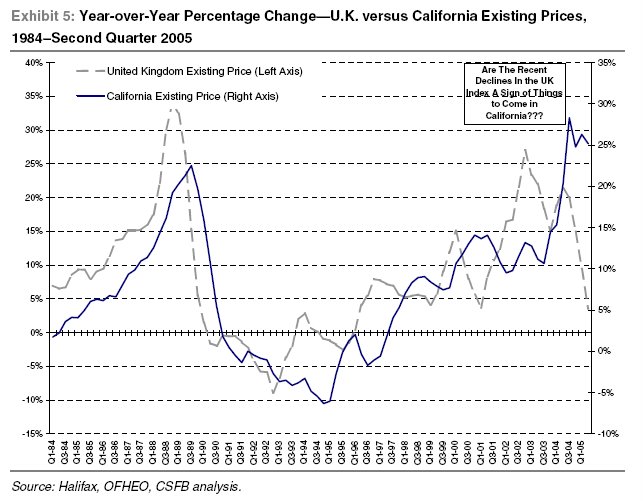

Home Prices
United Kingdom As shown in Exhibit 4, U.K. home prices have accelerated to an unprecedented 20% annual price appreciation over the last 3 years from 8% annual appreciation over the last 20 years.
California
Likewise, California home prices have followed a similar trend, increasing 15% per year over the last three years versus 7% annual appreciation over the last two decades.Exhibit 3 and Exhibit 4 compare the existing home price indices of California and the U.K. market. On a quarterly basis, prices have a surprising correlation at 99% since the beginning of our data series in 1983.
As you can see above the UK and California have a 99% correlation in home price appreciation over the last 23 years with the UK leading 12-15 months. If you want to see the future of home prices in California, just look to our friends over the pond. The UK market has rebounded the latter half 2006 with appreciation in markets from 6-10% (see post from October 12th).
The future of CA in 2007/8 bodes well ............
Source Credit Suisse First Boston Sept 13, 2005
Thursday, October 19, 2006
California Rental Market Strong
Looks like a strong economy to me................
A Home Market That's Tight: Rentals
Apartment rents climb 6% in California as they play catch-up with sale prices.
Playing catch-up with the recent run-up in home prices, rents in large apartment complexes posted strong gains across California in the third quarter, according to data to be released today.Rents rose an average of 6% in most of the state's biggest markets, Novato, Calif.-based research firm RealFacts said. Southern California remained the West's most expensive place to rent, and the San Francisco Bay Area saw the highest rent increases, RealFacts said.
The rental market is likely to tighten further with the state's stable job market attracting more people to move here, although rising rents could slow economic growth, analysts say."We have no trouble finding tenants," said Rafael Padilla, a commercial property broker who owns about 35 apartment units in West Los Angeles. "The influx of people is still tremendous. If I lose one tenant, there are three more behind them."The average rent in Los Angeles and Orange counties rose 7.4% to $1,546 during the third quarter, making the counties the most expensive among 28 Western markets, said RealFacts, which surveyed 12,000 apartment buildings of 100 or more units in 15 states.
Rents increased 7.6% to an average of $1,452 in Ventura County. The Inland Empire is becoming more of a landlord's market as well, with rents in Riverside and San Bernardino counties rising 6% to $1,129.In Silicon Valley, the average rent jumped 10.4% to $1,450, the first double-digit increase in the high-tech heartland since the end of the dot-com boom in early 2001. Then, Santa Clara County's average rent peaked at $1,959. For all of Southern California, occupancy rose 0.4 percentage point from a year earlier to 96.2%. RealFacts analyst Chris Bates said occupancy above 96% was generally considered fully occupied — meaning that renters were having increasing difficulty finding vacancies.
LA Times - By Annette Haddad, Times Staff WriterOctober 19, 2006
http://www.latimes.com/business/la-fi-rents19oct19,0,6721437.story?coll=la-headlines-business
A Home Market That's Tight: Rentals
Apartment rents climb 6% in California as they play catch-up with sale prices.
Playing catch-up with the recent run-up in home prices, rents in large apartment complexes posted strong gains across California in the third quarter, according to data to be released today.Rents rose an average of 6% in most of the state's biggest markets, Novato, Calif.-based research firm RealFacts said. Southern California remained the West's most expensive place to rent, and the San Francisco Bay Area saw the highest rent increases, RealFacts said.
The rental market is likely to tighten further with the state's stable job market attracting more people to move here, although rising rents could slow economic growth, analysts say."We have no trouble finding tenants," said Rafael Padilla, a commercial property broker who owns about 35 apartment units in West Los Angeles. "The influx of people is still tremendous. If I lose one tenant, there are three more behind them."The average rent in Los Angeles and Orange counties rose 7.4% to $1,546 during the third quarter, making the counties the most expensive among 28 Western markets, said RealFacts, which surveyed 12,000 apartment buildings of 100 or more units in 15 states.
Rents increased 7.6% to an average of $1,452 in Ventura County. The Inland Empire is becoming more of a landlord's market as well, with rents in Riverside and San Bernardino counties rising 6% to $1,129.In Silicon Valley, the average rent jumped 10.4% to $1,450, the first double-digit increase in the high-tech heartland since the end of the dot-com boom in early 2001. Then, Santa Clara County's average rent peaked at $1,959. For all of Southern California, occupancy rose 0.4 percentage point from a year earlier to 96.2%. RealFacts analyst Chris Bates said occupancy above 96% was generally considered fully occupied — meaning that renters were having increasing difficulty finding vacancies.
LA Times - By Annette Haddad, Times Staff WriterOctober 19, 2006
http://www.latimes.com/business/la-fi-rents19oct19,0,6721437.story?coll=la-headlines-business
Tuesday, October 17, 2006
Homebuilder Recovery signalling upcoming strength
Is the Gloom Lifting for Homebuilders?
Some good news on the housing front. Could all this jibberish about housing bubble be over done? The stock market could be signalling a spring fling in the housing market.........
Investors drove up shares of the major U.S. homebuilders Oct. 10 after JP Morgan upgraded DR Horton (DHI), Toll Brothers (TOL), and Standard Pacific (SPF), citing stabilized inventories, while the Dallas Fed president suggested fears of a housing correction were overblown.
"While pricing, orders, and starts may still show negative trends in the near-term, we believe inventories the leading driver of the market's pullback, in our view, as well as our prior cautious stance have begun to stabilize, and in turn should drive a market recovery," the bank said Oct. 10 in a research report.
And the Fed thinks so too..........
On the same day, in a question-and-answer session after a speech in London, Dallas Federal Reserve president Richard Fisher downplayed risks of a housing market correction, which he said was one of the "most over-anticipated in history."
Source: Business WeekPublication date: October 11, 2006
Some good news on the housing front. Could all this jibberish about housing bubble be over done? The stock market could be signalling a spring fling in the housing market.........
Investors drove up shares of the major U.S. homebuilders Oct. 10 after JP Morgan upgraded DR Horton (DHI), Toll Brothers (TOL), and Standard Pacific (SPF), citing stabilized inventories, while the Dallas Fed president suggested fears of a housing correction were overblown.
"While pricing, orders, and starts may still show negative trends in the near-term, we believe inventories the leading driver of the market's pullback, in our view, as well as our prior cautious stance have begun to stabilize, and in turn should drive a market recovery," the bank said Oct. 10 in a research report.
And the Fed thinks so too..........
On the same day, in a question-and-answer session after a speech in London, Dallas Federal Reserve president Richard Fisher downplayed risks of a housing market correction, which he said was one of the "most over-anticipated in history."
Source: Business WeekPublication date: October 11, 2006
Saturday, October 14, 2006
Dow Even Higher
Dow Sets Another Record
As 12000 Level Nears,Gut Check for Bears;'Yesterday's Trade'
October 13, 2006 11:57 p.m.
There's little question a shift has taken place on Wall Street in recent weeks. The bears are on their heels.
Only a few months ago, many market watchers were forecasting sharp declines for stocks. A sagging housing market, record-high oil prices and an implacable Federal Reserve on a mission to crush inflation with higher rates made the bearish argument for stocks convincing.
A lot has changed.
A gauge of the shift -- as well as a catalyst -- has been the record-setting run by the Dow Jones Industrial Average, which cracked its all-time high last week and set several more records this week. The Dow finished higher again on Friday, gaining 12.81 points to 11960.41, another record that put it closer to the 12000 level. The blue-chip average gained 110.30 points this week, leaving it up 11.6% for the year.
The Standard & Poor's 500-stock index gained 2.78 to 1365.61 Friday, putting it up 9.4% for the year, and the Nasdaq added 11.11 to 2357.29, up 6.9% year-to-date.
More and more investors are growing upbeat about the market. And as stocks continue to advance, bearish portfolio managers, often measured against one of the major benchmark indexes, are being dragged into the market, sometimes almost against the will.
"People are feeling like they have to be fully invested because they're all being measured against their peers," said Michael Panzner, vice president in sales trading at Collins Stewart.
Mr. Panzner, a self-professed bear, admits the rally has confounded his expectations for a sharp downturn.
-By SCOTT PATTERSON - WSJ
As 12000 Level Nears,Gut Check for Bears;'Yesterday's Trade'
October 13, 2006 11:57 p.m.
There's little question a shift has taken place on Wall Street in recent weeks. The bears are on their heels.
Only a few months ago, many market watchers were forecasting sharp declines for stocks. A sagging housing market, record-high oil prices and an implacable Federal Reserve on a mission to crush inflation with higher rates made the bearish argument for stocks convincing.
A lot has changed.
A gauge of the shift -- as well as a catalyst -- has been the record-setting run by the Dow Jones Industrial Average, which cracked its all-time high last week and set several more records this week. The Dow finished higher again on Friday, gaining 12.81 points to 11960.41, another record that put it closer to the 12000 level. The blue-chip average gained 110.30 points this week, leaving it up 11.6% for the year.
The Standard & Poor's 500-stock index gained 2.78 to 1365.61 Friday, putting it up 9.4% for the year, and the Nasdaq added 11.11 to 2357.29, up 6.9% year-to-date.
More and more investors are growing upbeat about the market. And as stocks continue to advance, bearish portfolio managers, often measured against one of the major benchmark indexes, are being dragged into the market, sometimes almost against the will.
"People are feeling like they have to be fully invested because they're all being measured against their peers," said Michael Panzner, vice president in sales trading at Collins Stewart.
Mr. Panzner, a self-professed bear, admits the rally has confounded his expectations for a sharp downturn.
-By SCOTT PATTERSON - WSJ
Thursday, October 12, 2006
British Housing Market Strong Again

Remember California and Great Britain have a 99% Housing Market Price Correlation. We're just a year or so behind..............
RICS UK Housing Market Survey September 2006
12 October 2006
45.1 percent more Chartered Surveyors reported a rise than a fall in September, up from 34.9 percent in August, and more than double the long run average of 21 percent. RICS estate agents reported that price rises are being driven by a combination of would-be buyers returning to the market and the limited availability of property.
Price increases were again led by London and the South East, boosted by the a booming City economy, with rising investor confidence pushing the stock market to its highest level since May. Estate agents report that ‘gazumping’ is taking place amid prices in the capital rising at the fastest pace since January 2000. Elsewhere, a ripple effect is taking place across the country with house prices in the North West and East Anglia picking up sharply, while Wales, Yorkshire and Humberside also recorded price rises.Buyer enquiries rose for the sixteenth consecutive month, the longest run on record.
Above trend economic growth combined with a strengthening employment market continued to boost buyer confidence but the rise is the smallest since April 2006. New instructions to sell property fell for the fourth month in a row, at the fastest pace since June 2002, indicating that households feel under little pressure to put their property on the market.Optimism in price rises is at its highest since October 2004. However, surveyors expect a modest slowdown in sales activity as interest rates are expected to rise again.
RICS UK Housing Market Survey September 2006
It's all about how confident the buyer feels, and once the fundamentals kick in, the U.S. should see stabilization and growth again.
Tuesday, October 03, 2006
Dow Hits All Time High


To quote Larry Kudlow, this is the greatest story never told. The economy is strong despite the main stream media's lack of acknowledgment................
Dow Industrials Close at a Record
Falling Oil Lifts the Mood,Which Is Far TamerThan at High in 2000
Hope for Goldilocks Economy
When the Dow Jones Industrial Average last closed at a record, on Jan. 14, 2000, it was a time of exultation. A lot has changed since then.
After flirting with the record for days, the Dow Industrials finally topped it yesterday, pushed higher by the hope that falling oil prices will support consumers and the housing market. The average rose 56.99 points to squeak past the old record close of 11722.98 with a finish of 11727.34. Throughout the market, the mood was more skeptical than during those heady days more than six years ago.
"A lot of people who were bearish are throwing in the towel and turning more positive," said David Briggs, head of stock trading at Federated Investors, a Pittsburgh mutual-fund group. "A lot of people have been sitting out this dance, and before we top out, I think we are going to get them in."
By E.S. BROWNINGOctober 4, 2006 -WSJ
Monday, October 02, 2006
New Homes Sales up 4.1%
It's Not All Bad News On The Housing Front
"The Census Bureau reported that sales of new homes rose 4.1% in August from a month earlier, to a seasonally adjusted annual rate of 1.050 million. The unexpected jump ran counter to other recent data depicting slowing sales."
From WSJ 9/27/06
"The Census Bureau reported that sales of new homes rose 4.1% in August from a month earlier, to a seasonally adjusted annual rate of 1.050 million. The unexpected jump ran counter to other recent data depicting slowing sales."
From WSJ 9/27/06
Tuesday, September 26, 2006
Silicon Valley on the Rebound
Silicon Valley is rebounding - a good sign for the future of Northern California........
Valley jobs keep climbing
8-MONTH UPWARD TREND FIRST SINCE FLUSH DAYS OF DOT-COM ERA
Silicon Valley's economy continued to turn in modest job growth in August -- a heartening sign of the region's ongoing recovery from the tech bust of 2000, economists said.
The California Employment Development Department said the addition of 2,600 jobs in Santa Clara and San Benito counties -- a gain of 0.3 percent from July -- marked the first time since 2000 that the region's employment had climbed each month since January.....
Steven Cochrane of Moody's Economy.com found another encouraging note in ``the best January-to-August showing since 2000.'' The state revised the region's non-farm job numbers for July upward by 2,000 jobs, from 873,100 to 875,100. ``That's another good indicator,'' he said. Earlier this year, the EDD had revised the previous month's job gains downward for three consecutive months.....
The unemployment rate in the San Jose-Sunnyvale-Santa Clara metropolitan statistical area -- a region that also encompasses San Benito County -- was 4.7 percent in August, down from 5.0 percent in July 2006 and 5.4 percent in August 2005, the EDD reported.
By Scott Duke Harris
Mercury News
Valley jobs keep climbing
8-MONTH UPWARD TREND FIRST SINCE FLUSH DAYS OF DOT-COM ERA
Silicon Valley's economy continued to turn in modest job growth in August -- a heartening sign of the region's ongoing recovery from the tech bust of 2000, economists said.
The California Employment Development Department said the addition of 2,600 jobs in Santa Clara and San Benito counties -- a gain of 0.3 percent from July -- marked the first time since 2000 that the region's employment had climbed each month since January.....
Steven Cochrane of Moody's Economy.com found another encouraging note in ``the best January-to-August showing since 2000.'' The state revised the region's non-farm job numbers for July upward by 2,000 jobs, from 873,100 to 875,100. ``That's another good indicator,'' he said. Earlier this year, the EDD had revised the previous month's job gains downward for three consecutive months.....
The unemployment rate in the San Jose-Sunnyvale-Santa Clara metropolitan statistical area -- a region that also encompasses San Benito County -- was 4.7 percent in August, down from 5.0 percent in July 2006 and 5.4 percent in August 2005, the EDD reported.
By Scott Duke Harris
Mercury News
Subscribe to:
Posts (Atom)